
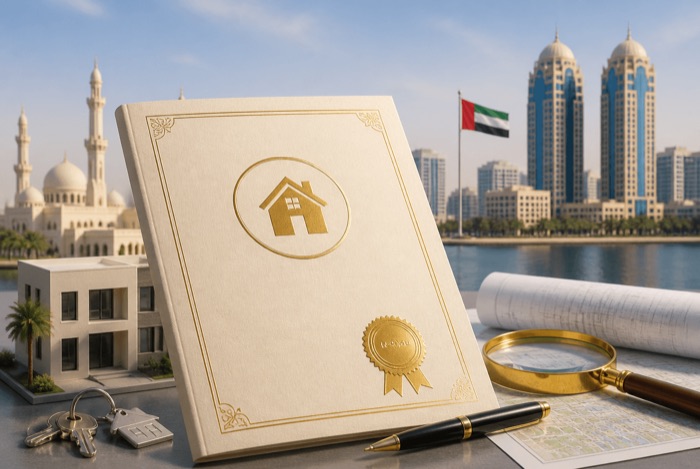
What is a title deed?
A title deed — sometimes called an ownership certificate — is the official document that legally records who owns a specific piece of real estate. In Ajman, it's issued by the Ajman Department of Land and Real Estate Regulation (AjmanRe) and typically records the owner's name, the property's location and plot or unit number, its registered area (built-up area, or BUA), the property type, and the date of registration.
This document is what turns a buyer from someone holding a signed sale contract into the property's actual legal owner under UAE law. Without a title deed in your name, you cannot sell the property on the open market, use it as collateral for a mortgage, or reliably prove ownership if a dispute ever arises. It is the single most important document in any Ajman property transaction, and it is the document every serious buyer, lender or heir will eventually need to see.
Title deed vs Oqood / initial registration
This is one of the most common sources of confusion for first-time buyers, especially those buying off-plan. "Oqood" (the Arabic word for "contracts") is the term originally used by the Dubai Land Department for the interim registration of an off-plan sale — essentially, a record that a buyer has purchased a specific unit from a developer before the building exists. Across the wider UAE property market, "Oqood" is now used loosely as shorthand for any pre-completion registration, even outside Dubai. In Ajman's own service documentation, this same pre-completion stage is generally referred to as an initial registration certificate.
The key distinction to understand:
- Initial/interim registration (Oqood-equivalent) — issued when an off-plan sale is registered with the land department. It confirms your purchase and secures your interest in the unit, but the project is not yet complete and you are not yet the final registered owner in the Real Property Register.
- Title deed — issued only after the property is fully constructed, handed over, and the ownership transfer is formally recorded in your name in the Real Property Register. This is full, final legal ownership.
In practical terms: if you buy off-plan in Ajman, expect to hold an initial registration certificate for the duration of construction, and to receive your title deed only at (or shortly after) handover, once the developer has completed the formal registration process with AjmanRe.
Who issues title deeds in Ajman?
Title deeds in Ajman are issued by the Ajman Department of Land and Real Estate Regulation (AjmanRe), the emirate's official real estate regulator, which also oversees broker licensing, developer regulation and the real estate register. Property registration services — including sale registration and title deed updates — are also accessible through the Department of Digital Ajman e-services portal, which acts as the emirate's central online gateway for government transactions, including real estate ones.
In practice, most transactions involve creating or using an existing account on the e-services portal to submit the application, with final signing of the transfer contract and fee payment completed in person at the department or an authorised registration trustee office.
Documents you need
Requirements can vary slightly depending on whether the transaction is a first-time developer sale, a resale on the secondary market, or a transfer through inheritance or gift, but the core documents typically requested are:
- Valid passport and Emirates ID (or residency visa page, for expats) for both buyer and seller.
- The original title deed or initial registration certificate currently held by the seller, proving they are the legitimate registered owner.
- A No Objection Certificate (NOC) from the developer, confirming there are no outstanding service charges or dues on the unit — required for almost all secondary-market (resale) transfers.
- The signed sale contract (Memorandum of Understanding or Sale and Purchase Agreement) setting out the agreed price and terms between buyer and seller.
- A Power of Attorney, if either party is not signing in person and is instead represented by a lawyer or authorised representative.
- A mortgage clearance letter from the bank, if the seller's property currently has an active mortgage registered against it, confirming the loan will be settled as part of the transaction.
Step-by-step: how to get a title deed in Ajman
The overall registration process for a completed (ready) property in Ajman generally follows these steps:
- Agree and sign the sale contract. Buyer and seller (or buyer and developer, for a new unit) sign a Memorandum of Understanding or Sale and Purchase Agreement setting out the price, timeline and conditions.
- Obtain the developer's NOC (for resales). The seller applies to the developer for a No Objection Certificate confirming all service charges and dues on the unit are settled — this is a precondition for registering the transfer.
- Submit the application. The transaction is initiated through the Department of Digital Ajman e-services portal, where an account is created (or an existing one used) and the required documents are uploaded.
- AjmanRe reviews and approves the application. The department checks the submitted documents and confirms the property's registration status.
- Both parties attend in person to sign. Buyer and seller (or their authorised representatives) visit the department, or an approved registration trustee office, to sign the official transfer contract.
- Pay the registration and issuance fees. The applicable registration/transfer fee and the fixed title deed issuance fee are paid at this stage.
- The title deed is issued. Once payment and signing are complete, the title deed (or ownership certificate) is issued in the buyer's name, and the Real Property Register is updated accordingly.
For a fully cash, straightforward resale with a cooperative developer and no mortgage involved, this process can move relatively quickly once the NOC is in hand. Transactions involving a mortgage, an inherited property, or an unresponsive developer for the NOC step typically take longer.
Registration fees and costs
Ajman's published fee guidance sets a registration/transfer fee of approximately 2% of the sale price for UAE and GCC nationals (with a minimum of AED 2,500), and approximately 3% for other nationalities (with a minimum of AED 3,000). On top of this, a separate, fixed title deed issuance fee of AED 350 applies. Who ultimately bears these costs — buyer, seller, or a split between the two — is a matter of negotiation reflected in the sale contract, though in practice Ajman buyers commonly end up covering most or all of the registration cost.
These figures sit alongside — and should not be confused with — a licensed agent's commission, which is a separate line item typically calculated as a percentage of the sale price and paid according to the brokerage agreement. Because fee schedules can be revised, always confirm the exact current rates directly with AjmanRe or the Department of Digital Ajman before finalising your budget, rather than relying solely on published guides.
Off-plan vs ready property: when is the title deed issued?
The timing of title deed issuance depends entirely on whether you're buying off-plan or a completed, ready unit:
- Off-plan purchases begin with an initial registration (the Oqood-equivalent) recorded when you sign with the developer and the sale is registered with AjmanRe. You hold this document — not a title deed — throughout construction. Only once the project is fully completed, handed over, and the developer finalises registration with the land department does a full title deed get issued in your name.
- Ready-property purchases (buying an already-completed unit on the secondary market, or directly from a developer's completed inventory) generally move straight to full title deed registration, following the standard process outlined above, without an interim registration stage.
This distinction matters most for buyers weighing off-plan versus ready stock — a topic covered in more depth in our guide to the EOI process for UAE off-plan launches, which explains what happens even earlier in the off-plan timeline, before a unit is formally reserved.
What a title deed is used for
A title deed isn't just a certificate to file away — it's required at several key moments in a property's life:
- Selling or transferring the property. No resale, gift, or ownership transfer can be legally registered without producing the current, valid title deed.
- Getting a mortgage. Once a bank approves a home loan, its mortgage interest is formally registered and annotated directly on the title deed. This annotation stays in place until the loan is fully repaid and the bank issues a clearance letter, at which point the mortgage is removed from the deed.
- Inheritance transfers. When an owner passes away, the title deed is a core document required to transfer the property to their legal heirs through the appropriate probate and registration process.
- Proving ownership for visa or investment purposes. A title deed is standard evidence of property ownership when applying for a UAE property investor visa, where eligibility generally starts from a property value of around AED 750,000.
- Dispute resolution. If an ownership dispute ever reaches a court or the land department, the title deed is the authoritative record used to establish who legally owns the property.
How to verify a title deed
Before completing any purchase — and especially on the secondary market — it's worth independently confirming that the title deed being shown to you is genuine, current and matches the actual property. In practice, this means:
- Cross-checking the details. Confirm the plot or unit number, registered area (BUA), owner's name and property location on the deed match exactly what's stated in the sale contract and what you've physically viewed — see our guide on plot area vs built-up area (BUA) for how these figures are meant to line up.
- Confirming ownership status directly with AjmanRe or through the Department of Digital Ajman e-services portal, rather than relying solely on a photocopy or PDF provided by the seller or agent.
- Checking for an active mortgage. A title deed with an unresolved mortgage annotation cannot be cleanly transferred until that loan is settled and the bank issues its clearance — this should be confirmed and addressed before you commit funds.
- Using a licensed broker or, where appropriate, a real estate lawyer to handle document verification on your behalf, particularly for higher-value transactions or purchases made from outside the UAE.
Several UAE land departments have moved toward electronic title deeds (e-Deeds) with digital verification features in recent years; if a digital verification option is available through AjmanRe or the Department of Digital Ajman at the time of your purchase, use it as an additional check alongside the in-person steps above.
Common mistakes and red flags
- Treating an initial registration certificate as full ownership. Holding Oqood-equivalent paperwork during construction is not the same as holding a title deed — don't assume final ownership is complete until the actual title deed is issued at handover.
- Skipping the developer NOC step. A resale application will be rejected without it — start this process early, since some developers take time to process NOC requests.
- Not checking for an existing mortgage on the seller's title deed. An unresolved mortgage can delay or derail a transfer if it isn't identified and addressed upfront.
- Assuming the registration fee is the only government cost. Budget separately for the fixed AED 350 title deed issuance fee on top of the percentage-based registration fee, and for agency commission, which is a distinct cost.
- Relying on outdated fee figures. Registration fee schedules can change — always confirm the current rate with AjmanRe before finalising your transaction budget, rather than relying on any single published guide, including this one.
- Not verifying the BUA figure on the deed against the actual unit. Discrepancies between the registered area and the real, physical unit are worth resolving before, not after, you complete the purchase.
For a fuller picture of the total costs and steps involved in buying property in Ajman — of which title deed registration is one part — see our complete guide to buying property in Ajman.