
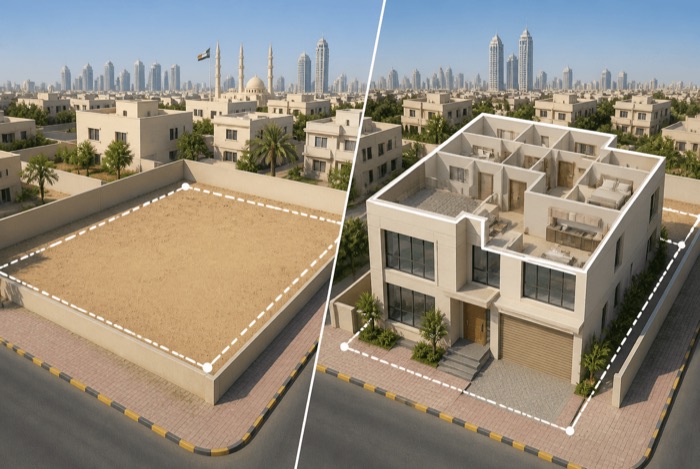
What is plot area?
Plot area is the total size of the land a property sits on — the full footprint of the parcel, including any garden, driveway, parking or open space around the building itself, not just the structure. It's measured in square feet or square metres and is the figure that defines how much land a buyer actually owns when purchasing a villa, townhouse or standalone plot.
Plot area is a land measurement, not a building measurement. A large plot with a modest house on it can still be a valuable asset because of the land itself — which matters for resale value, potential extensions, and how a property is valued relative to similar plots nearby.
What is built-up area (BUA)?
Built-up area, almost always shortened to BUA, is the total constructed floor area of a building — the figure that actually appears on a UAE title deed and in most property listings. It's measured from the outer face of the external walls and includes everything within that envelope: internal walls, columns, and typically a proportional share of shared spaces like lobbies, corridors and stairwells for apartments, plus balconies and covered terraces.
Across the UAE, land departments register properties by BUA, and it's the standard basis developers and agents use when advertising a price. If a listing simply says "1,200 sq ft," it's referring to BUA unless stated otherwise.
BUA vs GFA vs usable area
Three related terms get mixed up constantly, and each answers a different question:
- BUA (Built-Up Area) — the constructed floor area of a specific unit or building, used for registration, listings and pricing.
- GFA (Gross Floor Area) — a planning and development term used by municipal authorities to calculate how much floor area a developer is permitted to build on a given plot, based on the area's allowed floor area ratio (FAR). GFA is mostly relevant to developers and planners rather than individual buyers, though it explains why some plots support taller or denser buildings than others.
- Usable area (sometimes called carpet or net area) — the actual floor space inside a unit's walls that you can walk on and furnish, excluding wall thickness, columns and shared common areas. This isn't a term you'll usually see on a UAE title deed, but it's the number that determines how spacious a unit actually feels.
The gap between BUA and usable area is sometimes called a building's "efficiency ratio." A unit with an 85% efficiency ratio and a BUA of 1,000 sq ft has roughly 850 sq ft of real usable space; an efficiency ratio of 75% on the same BUA leaves only about 750 sq ft. That 100 sq ft swing is invisible if you only compare the headline BUA figures.
How BUA works for apartments
For an apartment, BUA covers the full internal footprint of the unit — bedrooms, living areas, bathrooms, kitchen, internal walls — plus balconies and a proportional allocation of the building's shared spaces, which is why identical-looking apartments in different buildings can carry different BUA figures even with the same room layout. A building with wide corridors, large lobbies or extensive shared amenities effectively "spends" more of each owner's BUA allocation on common space, leaving less of it as private, usable floor area.
This is why walking the actual unit, or at minimum reviewing a detailed floor plan, matters more than comparing BUA numbers alone. Two one-bedroom apartments both listed at 750 sq ft BUA are not guaranteed to feel the same size.
How plot area and BUA work for villas and townhouses
Villas and townhouses carry both figures, and they matter for different reasons. Plot area is the land you own outright — relevant to resale value, any future extension potential, and how much outdoor space (garden, driveway, pool area) you actually get. BUA is the built structure sitting on that plot — the house itself.
Two villas on identical plot sizes can have very different BUAs depending on how much of the plot the developer chose to build on versus leave as garden or setback space, and two villas with identical BUA can sit on very different plot sizes. In freehold villa communities like Al Zorah and Ajman Uptown, both figures are usually listed separately for exactly this reason — a buyer comparing villas needs to check both, not just one.
Price per square foot: BUA basis vs usable area
Advertised price-per-square-foot figures in the UAE are almost always calculated on BUA, because that's the registered, comparable figure across listings. The practical effect is that using BUA as the denominator makes a unit's headline price per square foot look lower than its effective cost per square foot of real, usable space.
As a simplified illustration: an apartment priced at AED 1,200,000 with a 750 sq ft BUA works out to AED 1,600 per BUA square foot. If that unit's real usable area is closer to 620 sq ft (an efficiency ratio of roughly 83%), the effective price per usable square foot is closer to AED 1,935 — a meaningfully different number for the same unit. Neither figure is "wrong," but comparing two properties fairly means using the same basis for both, and understanding which one you're actually looking at.
Common buyer mistakes
- Assuming BUA equals usable space. BUA always includes walls, columns and shared areas — it is never the full amount of floor space you can actually furnish.
- Comparing an apartment's BUA to a villa's plot area. These measure completely different things and aren't comparable numbers.
- Ignoring efficiency ratio when comparing buildings. A newer building with slimmer walls and less shared corridor space can deliver noticeably more usable area for the same BUA than an older one.
- Not checking whether a villa's price reflects the land, the build, or both. A larger plot with a smaller, dated structure can still be more valuable long-term than a larger BUA on a cramped plot.
- Taking marketing floor plans at face value. Always cross-check a floor plan's stated dimensions against the BUA figure on the actual title deed or SPA before relying on it.
How this applies to Ajman properties
Ajman's freehold market spans both ends of this discussion: dense, BUA-driven apartment communities like Emirates City and Al Rashidiya, and villa/townhouse communities like Al Zorah and Ajman Uptown where plot area is a real, separate part of the value. Because Ajman's per-square-foot prices already run well below Dubai's — commonly 30-50% lower for comparable BUA, as covered in our complete guide to buying property in Ajman — getting the area basis right matters even more here, since a misread efficiency ratio can meaningfully change what looks like a bargain on paper.
For apartment buyers, the practical takeaway is to always request the unit's actual floor plan alongside its BUA figure before comparing it to other listings. For villa and townhouse buyers, ask for plot area and BUA as two separate numbers, and factor both into how you judge value — the land itself in a masterplan community like Al Zorah can hold and grow in value independently of the structure built on it.
Whichever property type you're evaluating, confirming both figures directly with the Ajman Land Department or a licensed broker before making an offer remains the safest way to avoid comparing numbers that were never meant to be compared.