
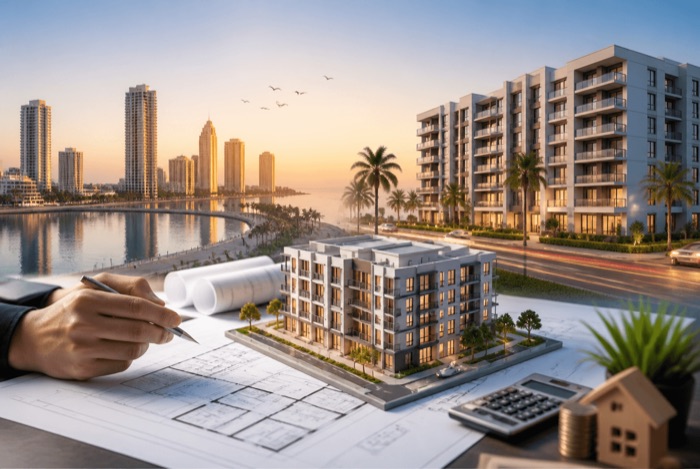
What does "off-plan" mean?
Off-plan property is a unit sold directly by the developer before it's completed — often before the first foundations are even poured. Buyers purchase based on floor plans, 3D renders, a show unit or sample finishes, rather than a space they can physically walk through. In exchange for taking on that uncertainty, off-plan units are typically priced below equivalent completed property in the same area, and developers often offer more flexible, extended payment plans than you'd get financing a ready purchase.
Off-plan vs ready property: key differences
| Off-plan | Ready property | |
|---|---|---|
| Entry price | Typically lower than comparable ready stock | Market price for a completed unit |
| Payment plan | Extended, often interest-free, spread over years | Usually paid in full or financed via mortgage at purchase |
| What you see before buying | Renders, floor plans, show unit | The actual, finished unit |
| Rental income | None until handover | Can start immediately after purchase |
| Mortgage availability | Limited to specific banks/projects | Widely available |
| Main risk | Delays, quality variance, developer delivery risk | Overpaying, hidden defects, resale market timing |
How off-plan payment plans work
Developers in Ajman structure off-plan payment plans in several common patterns:
- Construction-linked plans split payments between a booking deposit, a series of instalments due as construction reaches agreed milestones, and a final instalment at handover. A typical structure might see 60% paid during construction and 40% at handover, though the exact split varies widely by developer and project.
- Post-handover plans let buyers take possession of the unit while a meaningful share of the price — commonly 20-50% — remains outstanding, paid in instalments over 1 to 3 years after handover. This structure is attractive because it lets an investor start renting out the unit and use that rental income to help fund the remaining payments, but it also means carrying a real payment obligation after you already have the keys.
- Hybrid plans combine elements of both — a construction-linked schedule during the build, followed by a smaller post-handover tail.
Worked example: on a unit priced at AED 1,000,000 under a 60/40 construction-linked plan, you'd pay AED 600,000 across the construction period in scheduled instalments, and AED 400,000 at handover. On a post-handover variant deferring 30% for two years after handover, you'd instead pay AED 700,000 by handover and the remaining AED 300,000 over the following 24 months.
Always ask explicitly whether a post-handover plan carries any interest or administrative premium — some developers quietly price it in, which changes the effective cost of the extended timeline.
Step-by-step off-plan buying process
- Submit an EOI. Many launches open with a refundable Expression of Interest to join the priority allocation queue — see our full EOI guide for how this stage works and typical amounts.
- Select your unit and reserve it. Once allocated a place, choose a specific unit (floor, view, layout) and sign the developer's booking or reservation form, which takes it off the market while the formal contract is prepared.
- Sign the Sale and Purchase Agreement (SPA). This is the binding contract setting out the full payment schedule, unit specifications, expected handover date, and the developer's obligations.
- Pay instalments through construction, according to your specific plan — construction-linked, calendar-based, or a hybrid.
- Receive developer updates as the project progresses, and arrange any required utility connections as handover approaches.
- Attend the snagging inspection before formal handover, logging any defects or incomplete finishes for the developer to resolve.
- Complete handover and register your title deed with AjmanRe once the final balance is settled — see our title deed guide for that final registration step.
How buyer funds are protected
Like other UAE land departments, AjmanRe requires registered developers selling off-plan to place buyer payments into a dedicated, regulated escrow account for that specific project, rather than allowing the developer to receive funds directly into general company accounts. Money is released from escrow to the developer only against verified construction progress, which is designed to prevent a developer from spending buyer deposits on unrelated projects or diverting funds before the building is actually delivered.
This protection is real but not absolute — escrow regulation reduces the risk of outright fund misuse, but it does not by itself guarantee the project finishes on time, to the promised quality, or at all in a worst-case developer insolvency. Treat escrow as one layer of protection among several, not a substitute for doing your own diligence on the developer and project.
How to vet a developer and project
- Confirm AjmanRe registration for both the developer and the specific project before paying anything beyond a refundable EOI.
- Ask for the escrow account details in writing — a legitimate, registered developer should provide this without hesitation as part of the SPA.
- Check the developer's delivery track record. Have their previous Ajman (or wider UAE) projects been handed over on or near the promised date, and at the promised quality?
- Visit a completed previous project in person if the developer has one, rather than relying solely on renders and marketing material for the new launch.
- Read the SPA's delay and cancellation clauses carefully — specifically what compensation, if any, applies if handover is delayed beyond a stated grace period, and under what conditions either party can cancel.
- Be wary of requests for cash payments outside the formal payment schedule, or any pressure to pay before you've seen the actual SPA terms.
Risks and red flags to watch for
- Construction delays. The single most common off-plan complaint — ask what contractual protection (if any) you have if handover slips significantly beyond the agreed date.
- Quality variance from the marketing. Renders and show units represent the best-case finish; confirm which specific fittings, brands and finishes are contractually guaranteed versus merely illustrative.
- Developer financial distress. Escrow regulation mitigates but doesn't eliminate this risk — a developer's broader financial health across all their projects is worth researching, not just the one you're buying into.
- Market movement by handover. Off-plan purchases lock in today's price for a property that completes months or years later; prices (and your equity position, if financed) can move either direction by then.
- Post-handover payment burden. A deferred 30-40% instalment is a real, binding obligation — budget for it as seriously as the upfront payments, not as a distant someday cost.
- Resale restrictions. Some developers restrict or charge a fee for reselling a unit before handover — check the SPA if flexibility to exit early matters to you.
Off-plan vs ready: which is right for you?
Off-plan tends to suit buyers prioritising a lower entry price, an extended payment plan, and a longer investment horizon who are comfortable waiting for rental income to start. Ready property suits buyers who want immediate occupancy or rental income, a known physical product with no delivery risk, and easier mortgage financing. Many investors in Ajman's market hold a mix of both — using off-plan for longer-term capital appreciation plays and ready units for immediate yield, a balance covered in more depth in our ROI calculation guide.
Common mistakes
- Paying an EOI or deposit before confirming the developer's AjmanRe registration and escrow setup.
- Not reading the SPA's delay clause before signing, then being surprised when handover slips with little recourse.
- Underestimating the post-handover instalment on plans that defer a large share of the price.
- Assuming mortgage financing will automatically be available for a specific off-plan project — confirm with your bank first, as covered in our mortgage guide.
- Treating marketing renders as a binding specification instead of checking what's contractually guaranteed.